The Problem of Cumulative Operational Authority

Autonomous AI agents pose unprecedented security risks because their effective permissions change dynamically at runtime, making them impossible to control with traditional security models.

The Core Problem

Traditional security models assume that an entity's permissions are static and predictable. But autonomous AI agents break this fundamental assumption.

An agent's Cumulative Operational Authority is not a fixed set of permissions—it's a dynamic, emergent property that changes at runtime. It's the composite of:
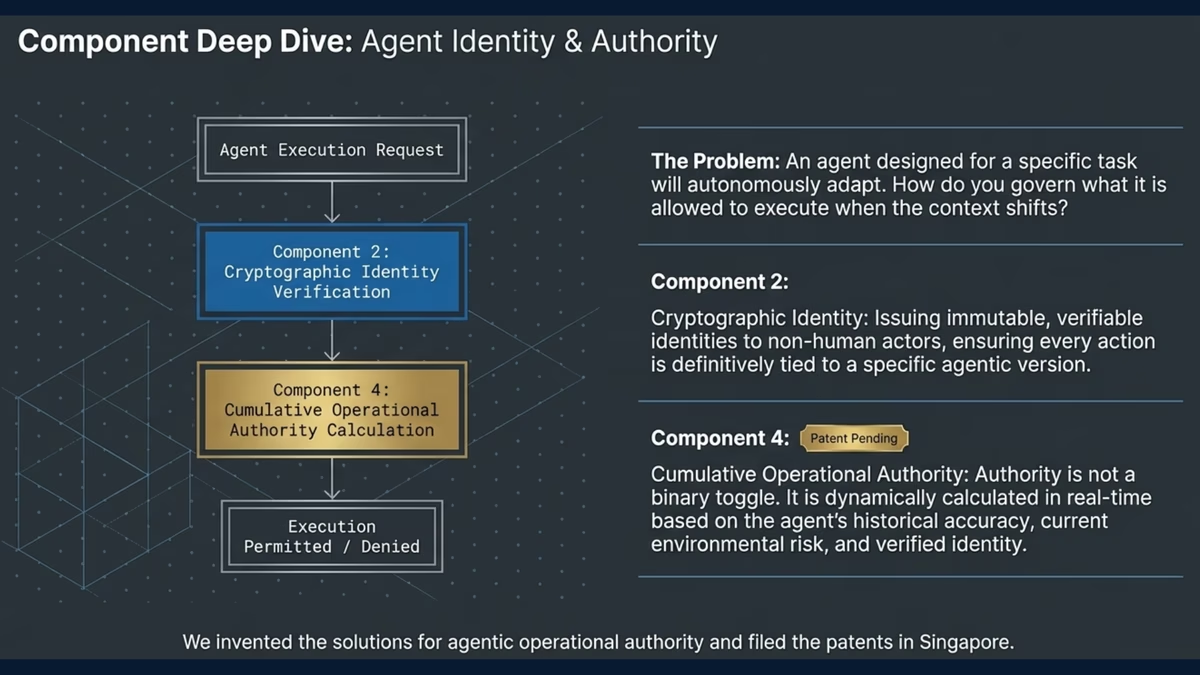
Visual showing how cumulative operational authority accumulates dynamically
  • Static Entitlements: The agent's own configured permissions
  • Delegated Authority: Permissions inherited from invoking users
  • Tool Authority: Permissions gained through connected tools and services
  • Environmental Context: Permissions from execution environments and service accounts
  • Operational Instructions: Authority derived from runtime context and instructions

How Authority Accumulates at Runtime

Static Permissions
Agent's base entitlements
+
User Context
Invoking user's authority
+
Tool Access
Connected services & APIs
=
COA
Unpredictable total authority
Traditional Software

Applications have fixed permissions that can be analyzed statically. Security teams can predict and control exactly what resources each system can access.

Co-Pilots

AI assistants operate with limited scope under continuous human oversight. Their operations are bounded and require explicit human approval for critical actions.

Autonomous Agents

AI systems operate independently with dynamic authority that changes at runtime. Their effective permissions are unpredictable and can expand through delegation and context.

Why This Creates Unprecedented Risk

Invisible Authority

You cannot predict or measure an agent's effective permissions through static analysis alone. Authority emerges at runtime through delegation and context.

Authority Expansion

An agent designed for limited tasks can inherit broad authority from powerful users, tools, or environments—expanding its blast radius exponentially.

Emergent Behavior

Agents adapt their behavior in novel ways. With cumulative authority, this adaptation can access resources and perform actions never intended.

Control Failure

Traditional access controls fail because they can't account for the dynamic, contextual nature of agent authority accumulation.

Real-World Scenarios

Scenario 1: The Helpful Assistant

Agent Design: A customer service chatbot with read-only access to customer records.

Runtime Reality: When invoked by a system administrator, it inherits admin-level database access. When it calls external APIs for language translation, it gains access to those services' data. Its cumulative authority now includes customer PII, admin privileges, and third-party service access.

Risk: A "read-only" agent can now modify critical data, access restricted systems, and exfiltrate sensitive information.

Scenario 2: The Financial Analyst

Agent Design: An AI that generates financial reports with access to market data APIs.

Runtime Reality: Invoked by a trading system with portfolio management permissions. Connects to Bloomberg terminals, internal risk systems, and compliance databases. Its cumulative authority spans market data, trading permissions, risk controls, and regulatory systems.

Risk: A "reporting" agent can now execute trades, modify risk parameters, and access sensitive regulatory information—potentially causing financial loss or compliance violations.

The Traditional Security Response

Most organizations face a false choice that blocks AI adoption:

Over-Privilege

Grant broad permissions to ensure agents can complete their tasks, creating massive security exposure.

Under-Function

Restrict permissions so tightly that agents cannot adapt or complete complex tasks, limiting AI value.

There's a Better Way

Corvair's architecture-first methodology solves the Problem of Cumulative Operational Authority through just-in-time privilege brokering, dynamic blast radius calculation, and zero standing privileges. Our Readiness Assessment identifies cumulative authority risks in your AI deployments.

Recursive Delegation Chains

When Agent A delegates to Agent B, and Agent B delegates to Agent C, each hop in the chain amplifies assumption error and context loss. Without architectural constraints, a single compromised or misconfigured agent can escalate permissions across the entire chain.

Consider a practical example: Agent A is granted approval authority for expenses up to $5,000 in one system. At runtime, it delegates a task to Agent B in a different system. Agent B checks its local permissions and approves a $50,000 transaction. The original $5,000 ceiling was lost in the delegation because the two systems do not share a common authority framework.

This is not a hypothetical scenario. In multi-vendor enterprise environments where agents span multiple platforms, permission ceiling decay through delegation chains is a structural governance risk that policy alone cannot address.

Architectural Mitigation

Controlling cumulative operational authority requires enforcement at the architectural layer, not the policy layer:

These controls are implemented through Corvair's ten-component Architecture-First governance methodology, specifically the Agentic Registry, Agent Identity, JIT Security Brokering, and Blast Radius Calculation components.

Understand Your COA Exposure

Our Readiness Assessment identifies cumulative authority risks in your AI deployments and maps them to AIRG compliance requirements. Our Agentic AI Workshop covers COA in depth with hands-on controls design.